
In O'Romeo, Shahid Kapoor plays dreaded gangster Hussain Ustara, whose life has been touched upon in S Hussain Zaidi and Jane Borges' book Mafia Queens.

'India has established probable cause to prosecute him for his role in terrorist attacks that resulted in 166 deaths and 239 injuries'
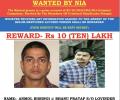
Gangster Anmol Bishnoi, a key accused in the murder case of NCP leader Baba Siddique and wanted in connection with the firing at Salman Khan's residence, is being deported to India from the US.

India on Thursday said it will pursue an extradition request with Canada for Arsh Singh Gill alias Arsh Dalla, the de-facto chief of the Khalistan Tiger Force, following his arrest in that country.
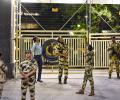
Tahawwur Hussain Rana, a Pakistani-born Canadian national accused of playing a role in the 2008 Mumbai terror attacks, has been extradited from the United States to India. Rana was arrested in the US in 2009 and convicted in 2011 for providing material support to the Lashkar-e-Taiba terror group, which carried out the Mumbai attacks. He had been fighting extradition since 2012, but the US Supreme Court ultimately denied his review petition, paving the way for his transfer to India. Rana will now face trial in India for his alleged role in the attacks, which killed 166 people.
The hugely significant development comes just days after Rana's last-resort attempt to evade extradition to India failed after the US Supreme Court justices denied his application, moving him closer to being handed over to Indian authorities to face justice in the dastardly attacks.
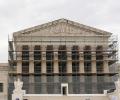
The US Supreme Court has denied the application of Tahawwur Rana, a Canadian national of Pakistani origin accused in the 2008 Mumbai terror attacks, seeking a stay on his extradition to India. Rana, currently detained in Los Angeles, had submitted the application after Associate Justice Elena Kagan initially denied it. Despite a renewed appeal, the Supreme Court ultimately rejected the request.

Mumbai terror attack accused Tahawwur Rana has moved an 'emergency application' with the United States Supreme Court against his extradition to India, claiming that he will be tortured there since he is a Muslim of Pakistani origin.
In a huge setback to Tahawwur Hussain Rana, a United States court has ruled that the Pakistani-origin Canadian businessman could be extradited to India where is wanted for his involvement in the 2008 Mumbai terror attack carried out by Pakistan-based Lashkar-e-Taiba terrorists.
This was Rana's last legal chance not to be extradited to India. Earlier, he lost a legal battle in several federal courts, including the US Court of Appeals for the North Circuit in San Francisco.

Tahawwur Hussain Rana, a Pakistan-born Canadian national and close associate of David Coleman Headley, could be extradited to India in connection with the 26/11 Mumbai terror attacks. Rana's travel history in parts of north and south India before the attacks in 2008 is expected to provide crucial leads for the investigation. His extradition would mark the third person to be tried in India for the attacks, after Ajmal Kasab and Zabiuddin Ansari alias Abu Jundal.
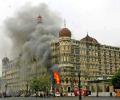
Tahawwur Rana, accused of involvement in the 2008 Mumbai terror attacks, is expected to be extradited to India from the United States soon. The US Supreme Court denied his last-ditch effort to stop his extradition, moving him closer to being handed over to Indian authorities. Rana's extradition is expected to help probe agencies expose the role of Pakistani state actors behind the attacks and shed new light on the investigation. He is associated with Pakistani-American terrorist David Coleman Headley, one of the main conspirators of the 26/11 attacks.

A protest march towards the Indian High Commission in Dhaka was halted by police, prompting India to express strong concerns about the security of its mission. The protesters demanded the extradition of former Prime Minister Sheikh Hasina and others involved in the 'July Uprising'.

A Bangladesh court has convicted former Prime Minister Sheikh Hasina and British MP Tulip Siddiq in a land scam case, sentencing them to imprisonment. The verdict also includes other government officials and Hasina's sister, raising questions about extradition and political motivations.

India is working closely with Belgium to extradite fugitive diamantaire Mehul Choksi, who was arrested in Antwerp on Saturday based on a formal request from the Indian government. Choksi is wanted by Indian probe agencies in connection with a Rs 13,500-crore bank loan fraud case involving the Punjab National Bank (PNB). His nephew, Nirav Modi, is also facing extradition proceedings in the UK.

The Bangladesh Foreign Ministry condemned the violence, citing threats to diplomatic personnel and establishments, and urged India to ensure their safety and security.
The HC posed the question to the 70-year-old liquor baron, wanted in India to face trial on fraud and money laundering charges, on his return home while hearing his twin pleas.

The much-anticipated deportation of Luthra brothers, Saurabh and Gaurav Luthra, from Thailand to India is now in its final stage, with top sources indicating they are likely to be sent back to India soon.
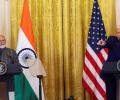
United States President Donald Trump on Thursday announced the extradition of the 26/11 Mumbai terror attack accused Tahawwur Rana to India and said he will face justice.
Maharashtra Chief Minister Devendra Fadnavis on Wednesday paid floral tributes at the city police headquarters to those who made the ultimate sacrifice while fighting terrorists during the 2008 Mumbai terror attacks.
Tahawwur Rana, accused in the 2008 Mumbai terror attacks, has renewed his application to the US Supreme Court seeking a stay of his extradition to India. The Supreme Court will hear the application next month. Rana, currently detained in Los Angeles, claims his extradition would violate US law and expose him to torture in India due to his health and Muslim background. The US government has denied these claims and authorized his surrender to India, citing the Extradition Treaty between the two countries. The Supreme Court's decision will determine if Rana will face justice in India or remain in the United States.
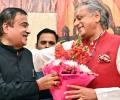
Senior Congress leader Shashi Tharoor welcomed the extradition of Tahawwur Hussain Rana, a key accused in the 26/11 case, and said everyone associated with the conspiracy of the Mumbai terror attacks must face the court of justice. He described Rana's extradition as a "step forward for justice." Rana, a Pakistan-born Canadian national and close associate of David Coleman Headley, is being brought to India after his last-ditch attempt to evade extradition failed. Tharoor expressed hope that the interrogation of Rana would provide more details about the Mumbai attacks and said he was "very glad" that Indian authorities managed to get Rana's custody.
Tahawwur Rana, accused in the 2008 Mumbai terror attacks, has renewed his plea for a stay on his extradition to India, citing health concerns and alleging potential torture. He argues that his extradition would violate US law and the UN Convention Against Torture. Rana's lawyers claim he is at risk of being subjected to torture in Indian detention facilities due to his Pakistani origin, Muslim religion, and medical conditions. The US Supreme Court had previously denied his emergency bid for a stay, but he has now appealed to Chief Justice John Roberts. The US government has declined to provide information on any commitment from India regarding Rana's treatment, further fueling his concerns.
Bangladesh's interim government has formally requested India to extradite deposed Prime Minister Sheikh Hasina, who is currently in India. The request has been made after Bangladesh issued arrest warrants for Hasina for "crimes against humanity and genocide." However, India has not yet responded to the request. Hasina is accused of using her security forces to oversee the abduction, torture, and murder of hundreds of activists during her time in office. She denies the allegations and claims she is being politically persecuted. The Bangladesh interim government's Chief Adviser, Muhammad Yunus, said he was shocked by the conditions he witnessed at one of the secret jails used during Hasina's regime.

'Pakistan will also try to turn Bangladesh into a base for terrorist attacks on India.'

A Bangladesh court on Thursday sentenced deposed prime minister Sheikh Hasina to 21 years in jail in three corruption cases related to irregularities in allocations of land in a government housing project.

'Pakistan's role in Bangladesh will always be negative, since it's a one-point agenda is hostility against India.'

The CBI has significantly increased the rate of fugitive repatriation, bringing back 134 individuals in the last five years, doubling the number from the previous decade. This success is attributed to enhanced diplomatic efforts, technological advancements, and improved coordination with Interpol.
A Delhi court has sought the trial records of the 26/11 terror attack from a Mumbai court ahead of the expected extradition of the crime's alleged mastermind Tahawwur Hussain Rana to India from the US. The US Supreme Court has cleared the way for Rana's extradition, dismissing his final legal challenge against the move.
The United States has approved the extradition of Tahawwur Rana, accused of involvement in the 2008 Mumbai terror attacks, to India. The decision was announced by President Donald Trump during a joint press conference with Prime Minister Narendra Modi in the White House. India is currently working on the logistics of Rana's surrender and extradition, with several final steps to be completed before he is sent back to India. The joint statement issued by India and the US during Prime Minister Modi's visit reaffirmed their commitment to fighting terrorism and eliminating terrorist safe havens. The leaders also called on Pakistan to bring to justice the perpetrators of the 26/11 Mumbai and Pathankot attacks. Rana, a Canadian national of Pakistani origin, is currently lodged at a metropolitan detention center in Los Angeles. He is associated with Pakistani-American terrorist David Coleman Headley, one of the main conspirators of the 26/11 attacks.
In a long battle, this is Rana's last legal chance not to be extradited to India.
Rajya Sabha MP Kapil Sibal has congratulated both the previous UPA government and the current dispensation for the extradition of Tahawwur Hussain Rana, the mastermind behind the 2008 Mumbai attacks. Sibal expressed confidence that the extradition will shed light on the involvement of individuals within Pakistan's establishment in the attacks. Rana is being questioned by the National Investigation Agency (NIA) to uncover the full extent of the conspiracy behind the deadly 2008 terror strikes. Sibal highlighted the efforts of the UPA government in establishing the NIA and pursuing Rana's extradition, and also acknowledged the current government's success in bringing him back to India. The interrogation is expected to focus on Rana's potential ties to the Lashkar-e-Taiba (LeT) and his role in the Mumbai attacks.
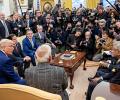
During the talks, India and the US decided to take a big leap in broad-basing their strategic ties in several critical areas.

Dhurandhar's most dangerous idea is that Director Aditya Dhar envisions an Indian state run by a deep state -- an intelligence machinery not accountable to Parliament, courts, or voters. A future political system where unelected officials decide when Indian democracy is 'fit' to function, observes Syed Firdaus Ashraf.
The bail plea of fugitive diamonds trader Mehul Choksi, wanted in India in connection with over Rs 6300-crore fraud in the Punjab National Bank (PNB), has again been turned down by a court of appeal in Belgium, just ahead of his extradition hearing before a court in that country, officials said. The court rejected the appeal on strong reasons conveyed by the CBI to the Belgian prosecution that Choksi had escaped from many jurisdictions earlier as well to evade legal proceedings and may flee to another country if let out on bail, they said.

Filing the Writ of habeas corpus through his attorney, Rana, 62, challenged his extradition by the Government of India. Rana's extradition would violate the United States-India extradition treaty in two respects, his attorney argued.

Anmol Bishnoi, the younger brother of jailed gangster Lawrence Bishnoi, has been arrested by US law enforcement authorities in Iowa. He is wanted in connection with several criminal cases in India, including the murder of NCP leader Baba Siddique and the firing outside actor Salman Khan's Mumbai home.

The FBI has arrested Cindy Rodriguez Singh, a woman on the agency's '10 Most Wanted Fugitive' list, accused of killing her six-year-old son and fleeing to India to evade prosecution.

The wife of an Indian doctor, allegedly detained in Sochi, Russia, appeals to the Indian government for help in securing his release and safe return to India.
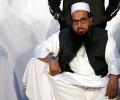
External affairs ministry spokesperson Arindam Bagchi said the request for extraditing Saeed along with certain documents was recently sent to Islamabad.
